
Our Heritage
Discover our curated collections of fine jewelry, where each piece stands as a testament to exceptional craftsmanship and timeless design.
Ruby, Emerald & Diamond Polki
GuluBandh Neckpiece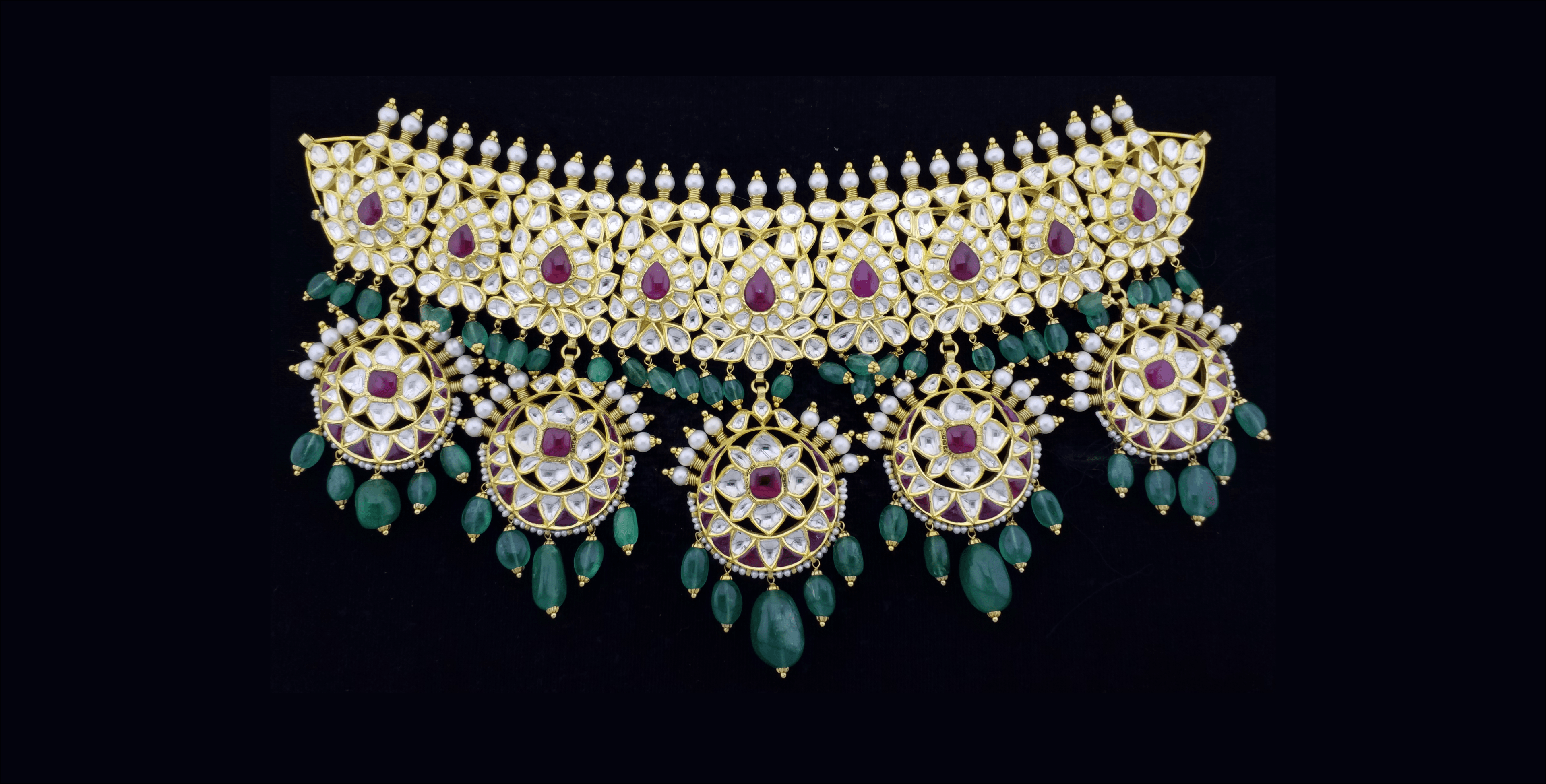
An important Gold necklace with openworked segments in synchronised fashion, all kundan-set with irregular and flat cut diamonds. The upper edge is crowned with 27 small gold cups each holding a pearl. A row of Chaand shaped suspensions is attached to the lower rims, each chaand with 7 such gold cups. Attached to the necklace are Zambian emeralds as suspensions. African Rubies and emeralds are in stark combination with Polkis characterised by a flat table top.
The reverse is densely enamelled in champlevé technique with stylised flowers in red- and green-enamelled foliage on an opaque white ground (safed chalwan).
Diamond Legacy
In Indian mythology, diamond is referred to as vajra (meaning 'thunderbolt'), hence it is the magical weapon of Indra, god of the heavens and the chief deity of the Rigvedic pantheon. In ancient Sanskrit texts, diamond is referred to as hira or hiraka (the jewel above all others).
According to the earliest historical records, rough diamonds date back some 3,000 years, and India was one of the earliest countries to mine the mineral. To this day, diamonds in India are stones of destiny, cherished because of their brilliant purity and flashes of fire, their spiritual value, their symbolic position in the zodiac and their role in astrology.
Ruby Mystique
Rubies have been loved for thousands of years in India, and legends circulate that God first created rubies and then created man to possess them. In Hindi, the ruby is referred to as manak or manikya; the name ruby is derived from the Latin rubeusmeaning 'red'.
In Indian mythology, ruby was given the name ratna raj, meaning 'king of jewels' and Ratnanayaka, meaning 'Lord of Precious Stones'. Padmaraga, or 'red as the lotus', was used to describe the beauty of the stone.
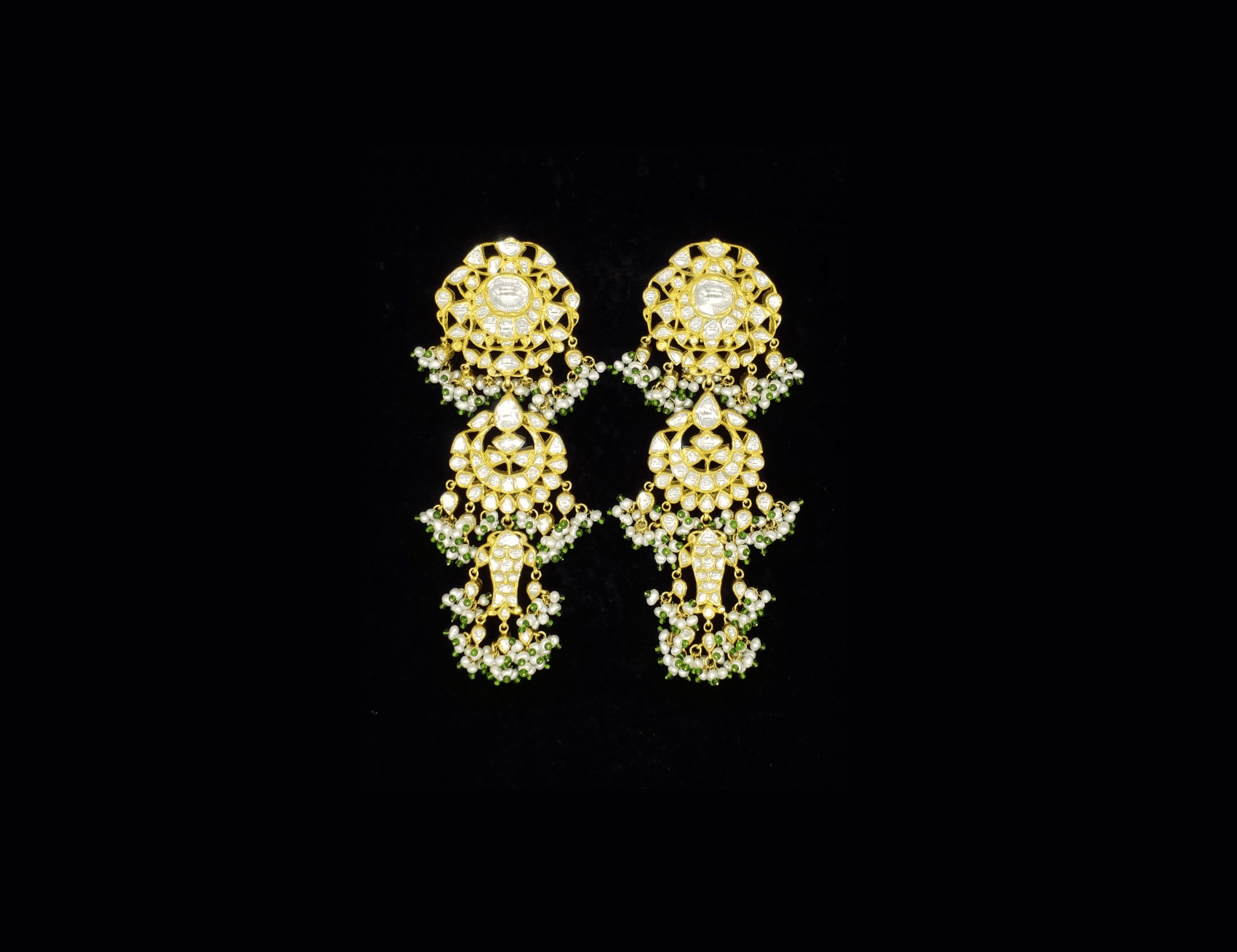
Gold bale, jhabbedar,
Ear Pendants
Elaborate pair of gold bale jhabbedar consisting of three parts. The top floral circular rosette is kundan-set decorated with diamonds. The 'Chaand' shaped central part contains further four smaller pendants. The third and bottom 'fish' shaped pendant are set on both sides with diamonds, fringes of pearls and green glass beads.
The Bale shows multicolored enamel at the reverse.
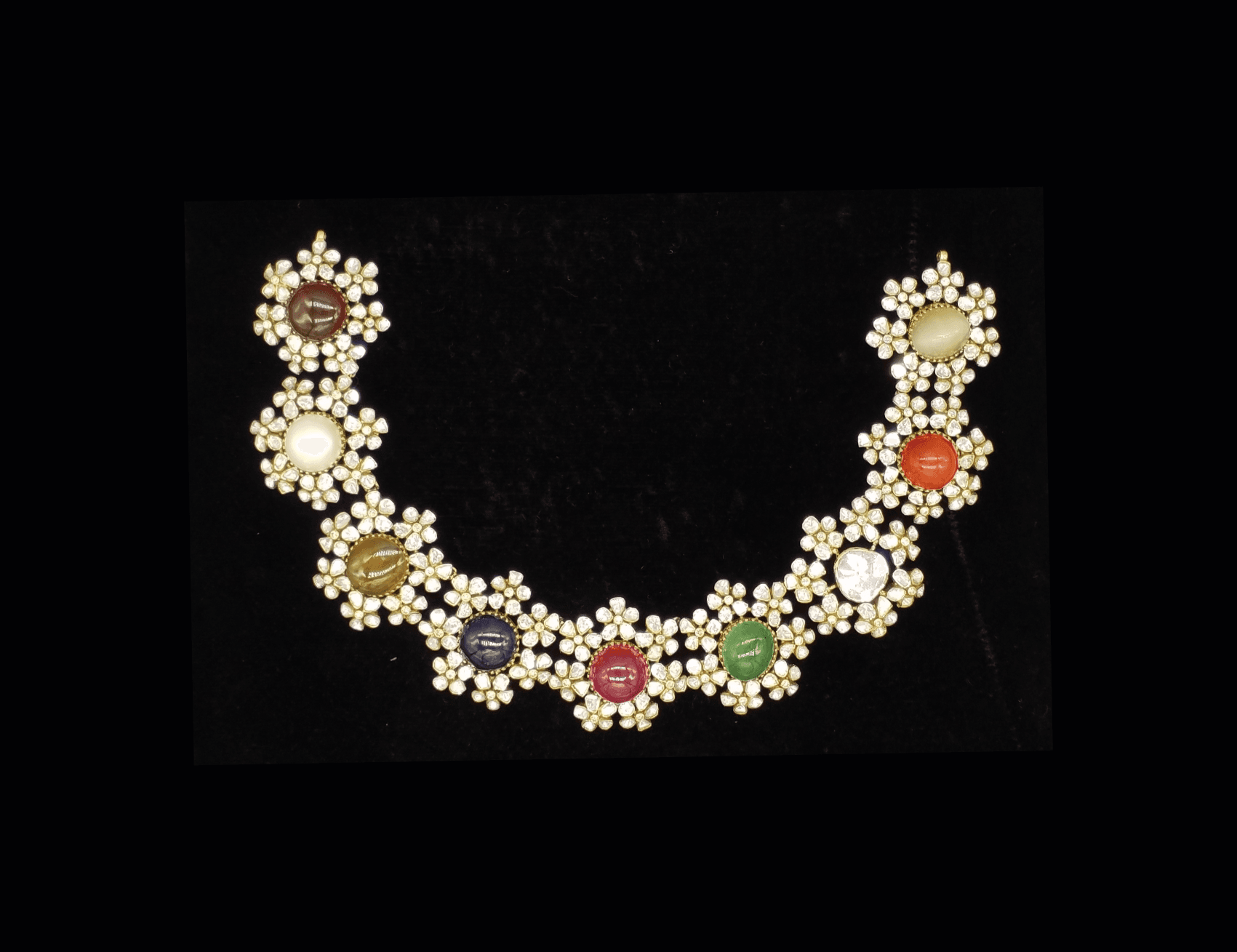
Navratan Haar
In the science of Hindu astrology, the concept of Indian gemology is based on planetary influence and is said to yield fruitful results and changes for better living conditions. Every human is under the influence of nine planets, represented by nine gems. Only Mercury, Venus, Mars, Jupiter and Saturn are recognised as planets, but there are also Rahu, the ascending node and Ketu, the descending node, known in Hindu mythology as the 'shadow' planets.
The 'Bhavopansihad' describes the Human Body as an island with nine gems. The nine gems are thought to protect nine parts of the human body: flesh, fat, bones, hair, feelings, marrow, lymph, blood and sperm; the number nine is consider to be a holy number.
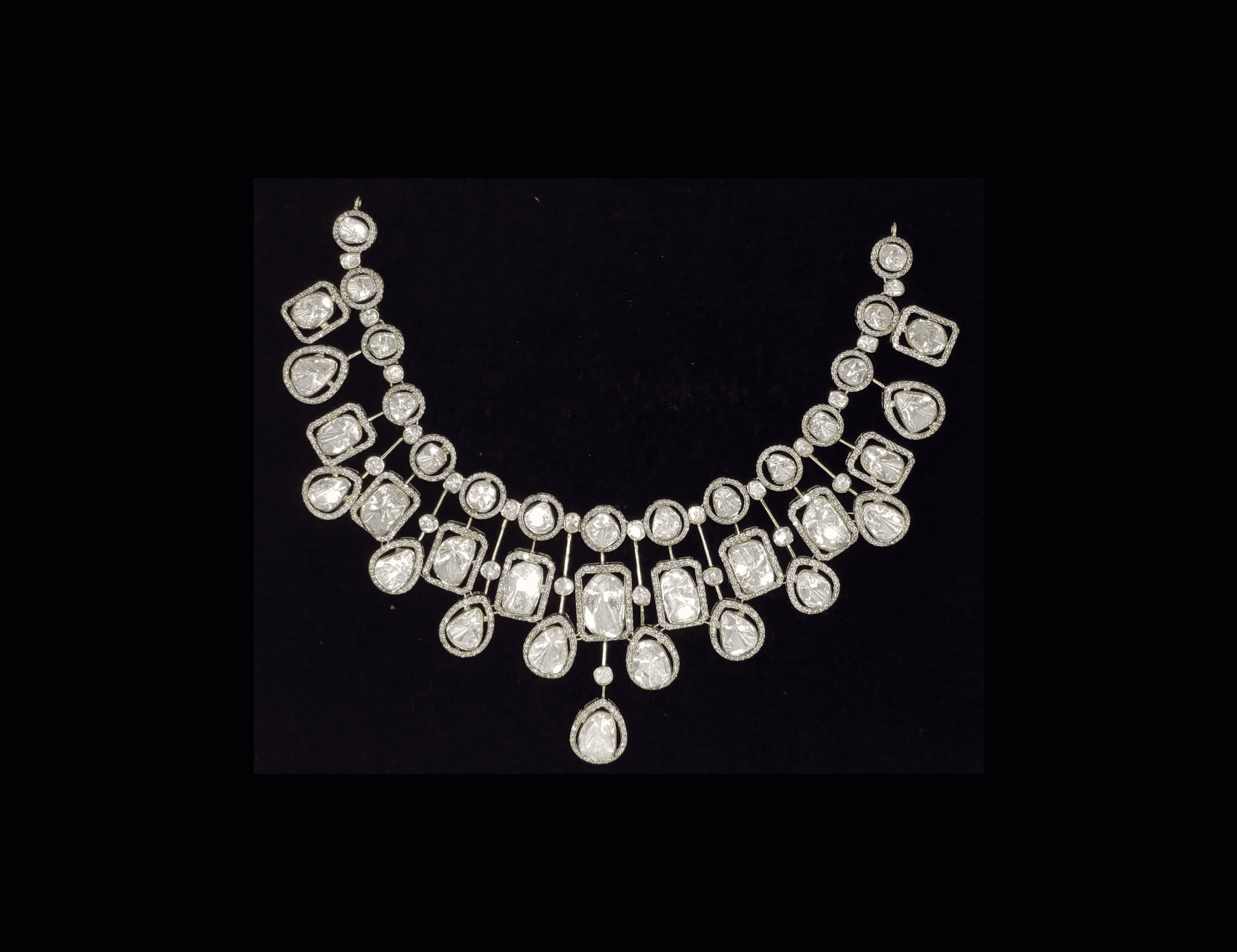
Diamond Necklace
The stylish encounter between the princely India and the West reaches a high point in this necklace. The setting of exceptional Diamond Polkis reflects the taste for asymmetric design. The creative dialogue between Indian princes and European Jewellery Houses in the earlier twentieth century is evident in this magnificent piece.
It represents the Zenith of designing between East and West in jewellery through our use of meticulous methods of manufacture to make a newly envisioned concept of traditional Indian ceremonial jewellery.
"Where tradition meets artistry, and every piece tells a story of timeless beauty"